
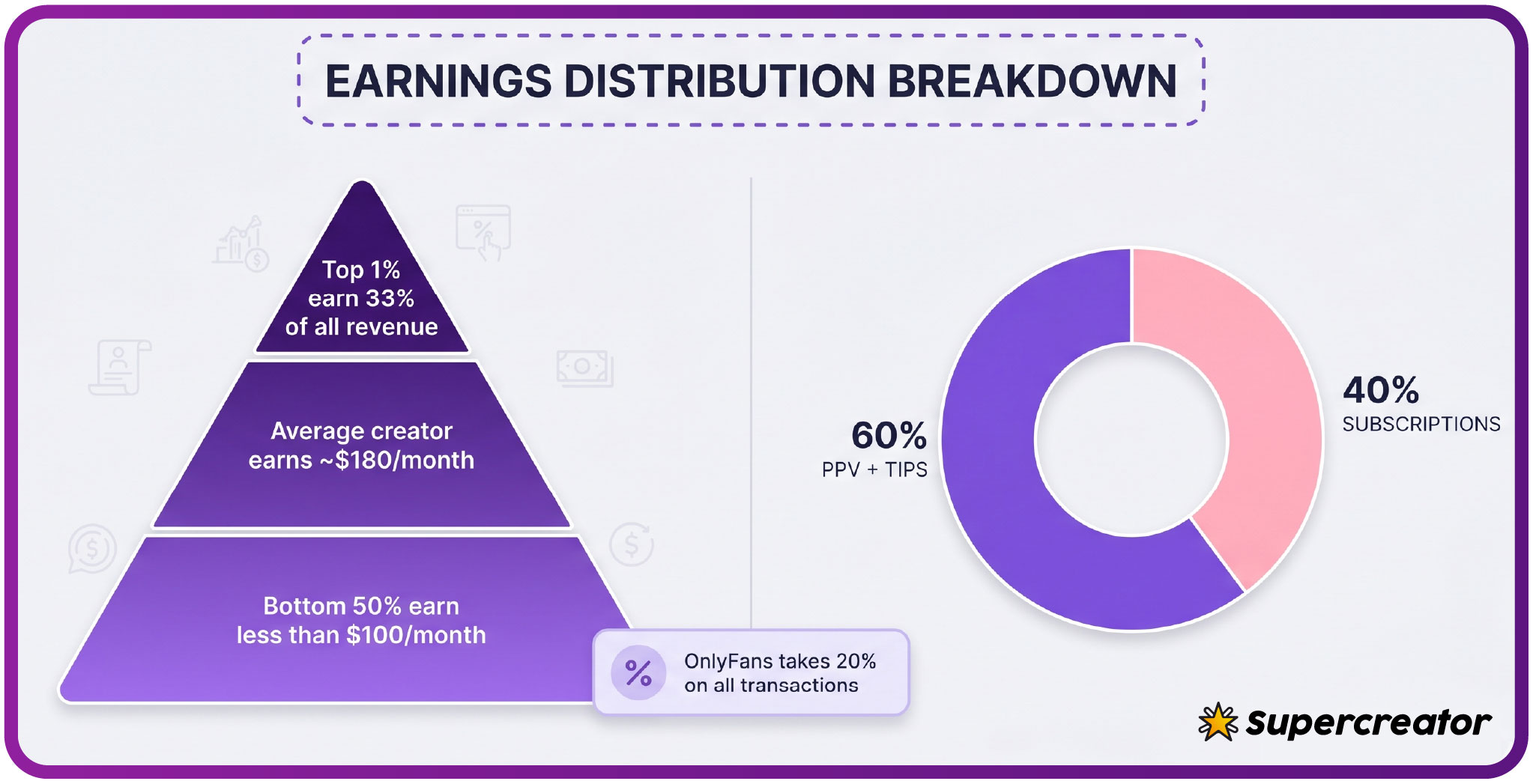
OnlyFans creators who run free pages earn nothing from subscriptions, so every dollar of income comes from pay-per-view (PPV) messages and tips. If you subscribe to a no-subscription page expecting free content, the PPV pricing logic is what determines whether that page is worth following. This guide explains how creators set those prices, how bundles work, and how to judge value before you unlock anything. BestOnlyFans refreshes its rankings every month.
Understanding the creator’s side of the equation changes how you read an unlock request. A $12 message is not an arbitrary number; it reflects production time, audience size, and a revenue target that a $0 subscription cannot meet. The sections below walk through that math from a subscriber-analytics perspective, so you can compare pages on equal terms. The BestOnlyFans method stays consistent across updates.

The Revenue Imperative Behind Free Pages
A free page sets the base subscription at $0, which removes the predictable monthly income that paid pages rely on. That means the entire revenue target must be met through PPV unlocks, paid chat, and tips. The platform fee stays at 20% on everything, so the creator keeps 80% of each transaction regardless of source.
This structure pushes creators toward higher per-item pricing than you would see on a paid page. On a $9.99 subscription page, a creator with 500 subscribers collects roughly $4,000 before fees without selling anything extra. On a free page, that same creator needs hundreds of individual unlocks and tips to approach the same figure. The pricing you see in your inbox is a direct response to that gap.
| Revenue Source | Creator Keeps | Strategic Importance |
|---|---|---|
| PPV unlocks | 80% | Primary income; scales with list size and message frequency |
| Paid chat messages | 80% | Steady, recurring contact income commonly priced at $3-$5 per message |
| Tips | 80% | Volatile but high-ceiling; single tips can reach $100 |
Because no single stream is guaranteed, most free-page creators run all three at once. PPV provides the bulk of revenue, paid chat smooths out slow weeks, and tips reward the creators who build genuine rapport. For subscribers, this means the page’s economics are visible in how often you receive offers and how aggressively they are priced.

How PPV Message Pricing Is Structured
PPV messages unlock for up to $50 per item, and most creators price well below that ceiling. The band runs from a few dollars for a single clip to the maximum for a full-length feature or a large gallery. There is no platform-set price within that range; every number is the creator’s own decision.
Creators calibrate against five practical determinants rather than guessing. The list below reflects what consistently shows up in how prices are set across niches.
- Content production time and resources, including equipment, editing, and shoot setup
- Exclusivity duration, meaning how long the item stays off other platforms
- The creator’s established audience size, since larger lists support lower per-item prices
- Comparable rates charged by other creators in the same content niche
- Minimum viable daily revenue needed to justify the production schedule
Paid chat sits in a narrower band, commonly $3-$5 per message, because it is a conversational product rather than a produced asset. Tips have no fixed price at all, though a single tip can reach $100. A creator with a small list will usually price PPV higher, while a creator with a large list can profit from volume at lower prices.
Tip: If a creator’s PPV prices sit at the top of their own historical range without a stated reason, wait a week. Prices on free pages move often, and the same item is frequently re-offered lower to a segment of the list.
Content-Length and Price Correlation Patterns
Across creator economy data, price clusters track format more closely than any other variable. Subscribers comparing two offers can use format as the first filter, then adjust for niche and creator size. The table below maps standard offerings against the ranges they usually fall into.
| Content Format | Typical Duration/Quantity | Common PPV Price Range |
|---|---|---|
| Short clip | 1-3 minutes | $3-$8 |
| Medium video | 5-15 minutes | $10-$25 |
| Full-length feature | 20+ minutes | $25-$50 |
| Small photo set | 10-20 images | $5-$12 |
| Large gallery | 50+ images | $15-$35 |
The relationship is not perfectly linear, and creators do deviate. A short clip from a creator with a niche skill set can outsell a longer generic video. Likewise, a large gallery assembled from an existing shoot costs less to produce than a custom video, so galleries tend to be priced more gently. When a price breaks far from the pattern, the preview description usually explains why.

Bundle Offers and Bulk Discount Mechanics
Bundles exist because a single large transaction costs the creator less effort than five small ones. Grouping items lets them lower the per-unit price while raising total revenue, and it gives subscribers a clear discount signal to evaluate. Most free pages cycle through a handful of repeatable structures.
- Weekly content packages that combine everything produced in a seven-day window
- Themed photo-video sets built around one concept or shoot day
- Retrospective archives that resurface older content at a reduced per-item rate
- Personalized thank-you bundles sent to subscribers who tip regularly
- Holiday and seasonal compilations timed to calendar events
To check whether a bundle is genuinely discounted, divide the total price by the number of items and compare that figure to the creator’s usual single-item rate. If the per-unit number is not lower, the bundle is packaging rather than saving. Reputable creators state the item count in the offer, which makes this arithmetic straightforward.
Tipping as Complementary Revenue on Free Pages
Tips are the least predictable income stream on a free page, and creators treat them as a buffer rather than a plan. A single tip can reach $100, but nothing guarantees one arrives in a given week. Because of that, tips are solicited in specific, contextual moments rather than constantly.
- Post-unlock appreciation after a subscriber buys a PPV item
- Prioritized message response, where tipping moves a conversation up the queue
- Custom content seed funding, where a tip starts a commissioned request
- Milestone celebration gestures tied to follower or post counts
- Ongoing supporter relationship maintenance for repeat buyers
For subscribers, tips function as a relationship signal more than a purchase. The 20% platform fee applies here exactly as it does elsewhere, so the creator keeps 80% of every tip. This is also where the community side of the niche becomes relevant; many subscribers compare notes and pricing experiences in spaces like a free onlyfans discord before committing money to a new page.

Spotting Value Versus Inflated PPV Pricing
Not every high price reflects real production cost. The warning signs below appear repeatedly when subscribers compare notes on pages they regret funding. Treat them as filters rather than proof, since context still matters.
- Content recycled from other platforms and resold as new
- Minimal production effort visible in the preview frames
- Vague preview descriptions that avoid stating length or item count
- Pricing far above the creator’s own historical average for similar items
- Pressure tactics built on artificial scarcity claims that reset weekly
Value assessment starts with the preview. A creator confident in the product will state duration, item count, and what makes the item distinct. Beyond that, track what you have already paid this creator and compare. A sudden jump from $10 to $40 for the same format deserves a question, and most creators will answer it directly.
The ranking methodology behind BestOnlyFans weighs pricing consistency alongside production quality, which is why a creator’s price history matters more than any single offer. Low prices on weak content are not value, and high prices on strong content are not automatically a rip-off. The ratio between the two, measured over time, is what tells you whether a page earns its place in your budget.

Budgeting PPV Purchases Across Multiple Free Pages
Free pages make it easy to follow a dozen creators and easy to overspend without noticing. Because there is no subscription fee acting as a natural brake, the budget has to be structural rather than self-imposed willpower. A simple allocation system solves most of the problem.
- Set a fixed monthly maximum for each creator you follow
- Prioritize creators with an established record of delivering what they advertise
- Reserve roughly 15% of the total budget for impulse unlocks
- Track price per minute for video content so formats stay comparable
- Review spending patterns quarterly and cut pages that no longer deliver
Two mechanics are worth remembering when a creator raises prices. When the price changes, auto-renew stops, and existing access lasts until the paid period ends. Verification also places a $0.10 hold on your card, which is refunded within days, so a small pending charge is not a pricing error. Promotional first months can sit below $4.99, such as $3 for the first month, while base prices on paid pages run from $4.99 to $49.99 and typically cluster between $5 and $10.
Finally, remember that OnlyFans has no built-in discovery feed or directory. That absence is why ranking sites and community comparisons exist, and why subscriber-side research pays off. A creator with no ranking presence is not necessarily poor value, but you have less external data to check pricing against.

FAQ
What is the maximum price a creator can charge for a single PPV message?
A single PPV message can unlock for up to $50. That is the platform ceiling, and most creators price below it. Items at the top of the range are usually full-length features or very large galleries rather than short clips.
Do creators earn more from PPV on free pages or subscriptions on paid pages?
It depends on list size and conversion rates, not on the model itself. Paid pages provide predictable monthly income from subscriptions priced between $4.99 and $49.99. Free pages require constant PPV and tip activity but carry no subscription ceiling. Many creators run both simultaneously.
How can I tell if a PPV bundle actually offers discount value?
Divide the bundle price by the number of items included, then compare that per-unit figure to the creator’s normal single-item rate. If the per-unit number is not lower, you are buying packaging rather than a discount. Legitimate bundles state the item count clearly.
Are tips on free pages subject to the same 20% platform fee as subscriptions?
Yes. The platform takes 20% on everything, including tips, PPV unlocks, paid chat, and subscriptions. Creators keep 80% of each transaction regardless of which revenue source it comes from.